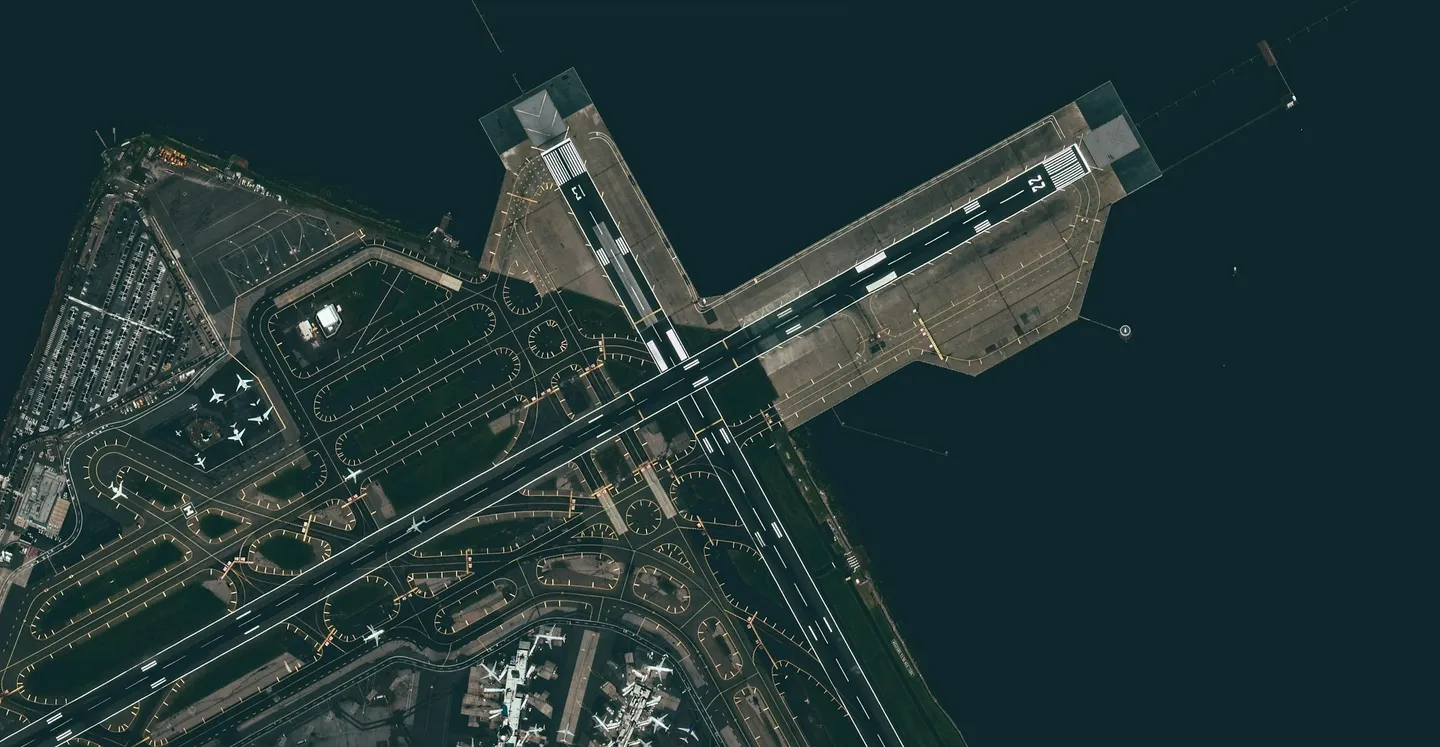
Every time a rocket lifts off from Cape Canaveral, hundreds of airline flights across the eastern United States have to adjust. Routes get replanned. Crews get rebriefed. Fuel gets recalculated. The mechanism that triggers all of this? A NOTAM.
If you’ve spent any time around aviation or aerospace, you’ve probably encountered the word. But NOTAMs are one of those things that everyone in the industry relies on and few outside it fully understand - including, often, the people peripherally affected by them. This article explains what NOTAMs are, why they look the way they do, how to read one, and why the rise of commercial spaceflight is exposing the limits of a system designed in the 1940s.
What Is a NOTAM?
NOTAM stands for Notice to Air Missions (historically “Notice to Airmen”). The formal definition, from ICAO’s Annex 15, describes it as a notice containing information about the establishment, condition, or change of any aeronautical facility, service, procedure, or hazard whose timely knowledge is essential to flight operations.
In plain terms: a NOTAM is how the aviation world communicates anything that affects the safety or planning of a flight.
NOTAMs cover an enormous range of situations - some of them critical, some of them remarkably mundane. A runway closed for resurfacing. A navigation beacon offline for maintenance. A military exercise temporarily restricting a block of airspace. A laser light show that poses a hazard to aircraft in the area. A change in airport landing fees. An update to the phone number for a ground handling company. A correction to a chart footnote. And increasingly, the airspace closures and debris field hazard areas required when a rocket launches from a nearby range. All of it arrives in the same undifferentiated stream, with no built-in indication of which items are flight-critical and which are administrative housekeeping.
That matters more than it might sound. Before every flight, a pilot is responsible for reviewing every NOTAM applicable to their route - and on a typical flight that list can run to dozens of items, sometimes more than a hundred. There is no priority ranking. A cyclone warning and a change to airport handling fees sit side by side in the same list, formatted identically. The pilot or dispatcher has to work through the entire thing to find what actually matters. And that’s just the NOTAMs for the departure and destination airports - the hazard areas and airspace restrictions along the route are a separate responsibility, split between airline flight planners (for NOTAMs issued in advance) and air traffic controllers (for dynamic events that develop in flight). NOTAMs are doing a lot of work across a lot of different contexts, and they were never specifically designed to handle all of it.
On any given day, there are roughly 35,000 active NOTAMs globally, with over 1.7 million issued each year. A dispatcher planning a transatlantic flight might need to review 150 or more before signing off on a flight plan. They’re not optional reading - a missed NOTAM can mean routing a plane into restricted airspace, landing on a closed runway, or violating crew duty limits.
A single NOTAM becomes readable once you know the structure. The harder problem is that there is no built-in priority ranking. A flight-critical space launch closure and an update to an airport handling agent’s contact details can appear in the same briefing, formatted identically. Working through a full preflight NOTAM briefing for a complex routing can take 30 to 45 minutes - and that’s before accounting for the NOTAMs that have been updated since the briefing started.
Why NOTAMs Look So Strange
If you’ve ever pulled up a raw NOTAM, your first reaction was probably confusion. They’re dense, abbreviated, and look like something generated by an old teletype machine. That’s because they were.
The NOTAM system was standardized by ICAO in 1947, at a time when aeronautical information traveled over the Aeronautical Fixed Telecommunication Network (AFTN) - a global network of teleprinter circuits where every character cost money and bandwidth was measured in dozens of characters per second. The format was deliberately compact to fit on narrow-carriage teletype tape and transmit as quickly as possible.
The cryptic five-letter codes you see - things like QMRLC or QWRAS - are called Q-codes. Each one encodes a subject (what’s affected) and a status (what’s happening to it) in just five characters. QMRLC, for instance, breaks down as: Movement area (MR), Closed (LC) - a runway closure. What looks like an obstacle is actually a remarkably efficient compression scheme designed for 1950s telecommunications physics.
The important thing to understand is that this format wasn’t a mistake - it was a feat of engineering for its era. The problem is that the era ended decades ago, and the format largely survived through regulatory inertia. Modern networks can handle rich structured data effortlessly, and due to the highly regulated and controlled nature of the processes involved, and the relative independence and variety of the organisations in the network, the airspace industry has not been able to keep up with advancements in technology.
The gap between what the technology could do and what the system actually does has real operational consequences. It is not uncommon to see, every day in sophisticated, modern air traffic control centres all over the world, an operator print out a NOTAM from one system, walk it across the room, and enter it manually into another. The data exists digitally at both ends. The connection between those systems simply doesn’t.
How to Read a NOTAM
Despite the intimidating appearance, NOTAMs follow a consistent structure. Here’s a simplified breakdown using a real example:
A) KJFK/20250610/001 A 1
B) 2506101200 2506101800
C) QMRLC/MR CLOSED
E) RWY 09L CLOSED FOR RESURFACING AND EQUIPMENT ON RUNWAY
The A line identifies the issuing authority (here, KJFK - New York’s airspace), a series number, and whether this is a new notice or an update.
The B line is the validity window. 2506101200 means June 10, 2025 at 12:00 UTC. 2506101800 means 18:00 UTC the same day - so this closure runs for six hours.
The Q-code line (C) encodes the type of event: QMRLC tells the system (and trained readers) this is a runway closure. Automated tools use this to filter and route the NOTAM to the right people.
The E line is the human-readable part: “Runway 09L closed for resurfacing and equipment on runway.” This is the only field written in plain language - and even then, it varies widely in quality depending on who issued it.
A dispatcher receiving this NOTAM might eventually find it somewhere in their stack, once they’ve worked through everything else. Once located, they’d assess whether alternate runways have sufficient capacity, recalculate fuel for any affected arrivals, and brief their crews on the change. Routine, but time-consuming - and only possible once the right NOTAM has been found in the first place.
For a complete field-by-field walkthrough of every part of the NOTAM format, including the full Q-line and a decoded space launch example, see the companion guide: How to Read a NOTAM: A Field-by-Field Breakdown.
Space Launches Are Breaking the System
Traditional NOTAMs describe static hazards - a closed runway, an offline navaid, a temporary obstacle. The event is known, the location is fixed, and the timing is certain. Dispatchers plan once and execute once.
Space launch NOTAMs are fundamentally different. They describe dynamic, probabilistic events with geometry that changes up until the moment of launch and timing that can slip by hours - or be scrubbed entirely and rescheduled for the next day.
When SpaceX launches a Falcon 9 from Cape Canaveral, the FAA issues an Altitude Reservation (ALTRV) - a block of airspace from the surface up to FL450 (45,000 feet), typically covering a roughly 100 nautical mile radius around the launch site. That’s a massive chunk of some of the busiest airspace in the world. Flights between the eastern US and the Caribbean, or on popular north-south corridors along the coast, may need to reroute entirely. But the ALTRV is only part of the picture - launches also generate NOTAMs covering debris field hazard areas along the rocket’s trajectory. These are the zones where spent boosters, fairings, or upper stages may fall, and airlines need to plan routes around them. Unlike a runway closure, these hazard areas are not circles centred on a fixed point; they’re elongated corridors that shift depending on the rocket’s planned trajectory, and they can stretch hundreds of miles out to sea.
What makes this costly is the uncertainty. A launch window might be listed as a four-hour period. The actual launch might happen at any point in that window - or the window might slip two hours due to weather. Or the launch might be scrubbed and rescheduled entirely. The NOTAM gets updated every few hours as the picture clarifies, right up until T-minus 30 minutes.
For a dispatcher managing 20 flights affected by a single launch event, this means continuously running contingency scenarios. Hold at the gate? Reroute to an alternate airway that adds 30 minutes and requires extra fuel? Depart early to beat the closure? Each option has cost and crew duty implications. Industry estimates put the operational cost of a 2-hour window uncertainty at $2,000-$5,000 per affected flight - and a busy launch day can affect dozens.
The current NOTAM system wasn’t designed for this. The Q-code format assumes a fixed location and a known start and end time. Probabilistic windows, dynamically shifting debris field geometries, and cascading multi-FIR impacts are essentially being forced into a container that wasn’t built for them.
Where It’s Heading: Digital NOTAMs and Plain Language
The good news is that the industry knows all this, and change is slowly underway.
Digital NOTAM, based on a data standard called AIXM 5.1 (Aeronautical Information Exchange Model), replaces the text-based format with structured data. Instead of a cryptic string of characters, a runway closure becomes a machine-readable event with precise coordinates, timestamps, and structured reason codes. Flight planning software can consume this directly, display it as a colored overlay on a moving map, and automatically flag which flights are affected. It’s worth noting that AIXM is built on XML - a format that was state-of-the-art around 2000-2005 and is now considered cumbersome and verbose compared to modern alternatives like JSON. The choice isn’t fatal, but it is characteristic of an industry that tends to standardise on technology just as the rest of the world is moving on from it.
Plain-language E-lines are being mandated in recent updates to ICAO Annex 15. Instead of terse abbreviations, the free-text field is expected to explain the event in clear English. The FAA’s 2022 NOTAM modernization initiative pushed this forward in the US, and early results show significant improvements in dispatcher comprehension.
Graphical NOTAM visualization - already appearing in tools like Jeppesen, LIDO, and Launch Window - allows dispatchers to see a closure as a shape on a map rather than a set of coordinates and a radius. For complex space launch geometries, including debris field hazard areas that don’t conform to simple circular shapes, this is genuinely useful.
And for space launches specifically, work is underway to extend the Digital NOTAM specification to support probabilistic windows: a structured way to say “the launch window opens at 14:00 and closes at 18:00 UTC, with the most likely launch time between 15:00 and 15:30.” Paired with real-time data APIs (through an initiative called SWIM - System Wide Information Management), this would let flight planning systems automatically update routes and fuel calculations as the launch readiness picture evolves.
Why This Matters Now
Commercial launch cadence has increased dramatically over the past decade. SpaceX completed 165 orbital launches in 2025 (all Falcon 9 missions) and five additional Starship test flights, bringing their total to 170. Blue Origin, Rocket Lab, United Launch Alliance, and international operators are all ramping up. Every one of those launches generates multiple NOTAMs affecting overlapping airspace across multiple jurisdictions.
The NOTAM system was built for a world where airspace closures were rare, predictable, and static. It is now being asked to handle events that are frequent, dynamic, and probabilistic - while still running on infrastructure that traces its lineage to 1940s teleprinters.
Better coordination tools and real-time status sharing between launch operators, airlines, air navigation service providers, and regulators are fundamental to how the airspace system will function at this launch cadence. The ability for commercial aviation and commercial spaceflight to coexist safely depends on all of those stakeholders working from the same picture at the same time.
That’s the problem Launch Window is built to solve.