A lot of excitement this week about SpaceX’s Starship going orbital, the Crew-13 launch, and other conversations about the future of space innovation.
SpaceX Confirms: How Starship Just Changed Everything!
What about it!? · 2 October 2026

Host Felix Schlang details the landmark Starship Flight 41 by SpaceX, lasting over three hours with successful dual orbits, 26 Starlink satellite deployments, and autonomous Pacific Ocean landing. The episode reveals major technical advances, regulatory shifts, and an accelerating launch cadence signaling a new era for spacecraft reusability.
In their own words
“The first rapid full reuse of Starship is a breakthrough required for space launch.”
- Elon Musk · 18:30
“Starship can launch even with lightning in the area.”
- Felix Schlang · 5:00
Key takeaways
- Starship Flight 41 completed nearly two full Earth orbits in 3 hours 8 minutes while deploying 26 Starlink V3 satellites, achieving roughly ten times the data capacity of prior Falcon 9 Starlink missions, and autonomously landed softly in the Pacific Ocean, signaling a major step for spacecraft operations beyond suborbital flights (Felix Schlang).
- The FAA removed lightning as a launch abort condition for Starship because its stainless steel body and tall grounded launch tower inherently dissipate lightning strikes, effectively eliminating a historic weather constraint that had hindered operations, especially relevant for future high-lightning sites like Kennedy Space Center and Starbase Louisiana.
- Starship’s ascent demonstrated engine resilience: despite one Raptor engine failure near max-Q on booster 21, the booster completed ascent flawlessly, then successfully employed 31 of 33 engines on the return burn, overcoming previous freeze and filtration challenges (Felix Schlang).
- For the first time, Starship operated fully as an orbital spacecraft, performing critical in-space maneuvers including shutting down one of six vacuum engines with no mission impact, re-igniting engines after over two hours in microgravity and extreme cold, managing fuel slosh, and proving the thermal protection tiles reused and improved from prior flight endure extended heat cycling in orbit and reentry.
- SpaceX’s rapid reuse strategy accelerates: they plan to catch Starship with the towering Mechazilla launch tower by end of October and rapidly relaunch the same vehicle by year-end or early next year, aiming to revolutionize space launch cadence with potential same-day reuse, despite skeptics (Elon Musk).
- Innovations in booster landing design include a 50% larger grid fin reduced from four to three fins to enable sharper landing angles, with Elon Musk proposing a future reduction to two fins controlled by aerodynamic yaw maneuvers, simplifying the system and lowering failure risks (Felix Schlang).
- Preparations for East Coast operations are underway: a new Starship launch platform at Kennedy Space Center passed a key water flow test, and the “Thank You Later” barge is preparing to transport vehicles from Texas to Florida where the first East Coast Starship missions could launch as soon as October, with rapid turnaround and possible first successful vehicle and booster catch using Mechazilla.
- SpaceX used waiting periods for FAA launch approval efficiently, conducting full wet dress rehearsals to validate countdown procedures and hardware readiness, demonstrating an adaptive approach that offsets regulatory delays with operational prep.
Starship makes it into orbit and searching for habitable worlds
Are We There Yet? · 30 September 2026 | 28:00

Don Platt, director of Florida Tech’s Spaceport Education Center, reviews SpaceX’s Starship successful orbit and challenges ahead for NASA’s Artemis mission. Howard Chen, Florida Tech space scientist, explores advanced models refining the search for truly habitable exoplanets beyond early optimistic assumptions.
In their own words
“SpaceX uses a ‘build a little, test a little’ philosophy instead of waiting for perfect designs prior to flight.”
- Don Platt · 4:00
“Despite early predictions, exoplanets are very common and diverse but none truly Earth-like have been confirmed.”
- Howard Chen
Key takeaways
- SpaceX achieved the first orbital flight of Starship with 26 Starlink satellites deployed and ocean landing, a crucial milestone for future NASA lunar missions and commercial satellite deployments, despite some engine failures needing resolution.
- SpaceX’s development approach contrasts NASA’s cautious methods by iterating through frequent, incremental flight tests to collect real-world data rather than waiting for perfect designs, speeding progress but increasing risk. (4:00)
- Successful Starship orbital test reduces NASA’s operational risk for Artemis III by validating both the Orion crew vehicle and Starship in orbit; yet Starship must extend mission duration, enhance life support, and complete complex testing before lunar crewed flights by 2028.
- Key technical hurdles remain including explaining and fixing persistent engine failures, demonstrating in-space propellant transfer within approximately six months, and finalizing multi-launch infrastructure with potential Florida launches pending FAA and data review.
- Howard Chen’s work on exoplanets leverages combined observational data and advanced 3D climate and atmospheric models to refine habitability assessments, revealing that early models overestimated habitability of systems like TRAPPIST-1 by neglecting complex physics and surface characteristics.
- Exoplanet research shows most discovered planets differ substantially from Earth in formation and environment, with no truly Earth-like planet found yet, challenging assumptions of life’s commonality and urging refined modeling of diverse planetary conditions.
- Tidally locked planets may experience extreme day-night temperature gradients, causing unique surface environment dynamics that classical Earth-based models cannot fully predict, highlighting the importance of multidimensional simulations.
BREAKING: Massive Surprises From Starship Flight 14! 🤯
Marcus House · 29 September 2026

Marcus House, a spaceflight commentator, analyzes SpaceX’s Starship Flight 14 as the longest and data-rich mission so far, highlighting an in-orbit engine failure, successful Starlink deployment, and thermal protection tests that inform future reusable rocket development and safety protocols.
In their own words
“All 33 Raptors fired perfectly at liftoff, pushing this 407-foot tall Starship off the pad with more than 18 million pounds of thrust.”
- Marcus House
“Despite losing one engine during ascent, the Starship design tolerates it without mission failure - a key to full reusability.”
- Marcus House
Key takeaways
- Starship Flight 14 experienced a vacuum Raptor engine shutdown during ascent, but SpaceX compensated by extending the orbital insertion burn to achieve stable orbit; this is the first time the orbital insertion burn was performed despite initial cancellation plans.
- The mission deployed 26 Starlink V3 satellites totaling around 52 metric tons with each satellite providing about 1 terabit per second bandwidth; three satellites included cameras to inspect the Starship’s exterior for future recovery efforts.
- Super Heavy booster landing was smoother and more accurate despite engine failures during descent related to icing; SpaceX uses three grid fins for aerodynamic control rather than engine thrust to slow descent.
- Starship’s thermal protection system was enhanced with new tile fixtures and curved designs tested during Flight 14, including reuse of tiles recovered from the prior ship Ship 40, aiming to improve heat resistance and plasma flow management during reentry.
- Flight 14’s operational flight lasted nearly two full orbits with four times more data collected than previous tests; however, the mission ended with an expected ocean crash of Ship 41 to preserve testing data and inform subsequent designs.
- Starship currently relies on passive thermal control without active cooling, radiators, or solar panels, making managing cryogenic fuel boil-off and tank pressures in orbit a significant engineering challenge.
Orbit Day - Starship Finally Takes A Big Leap
Scott Manley · 29 September 2026
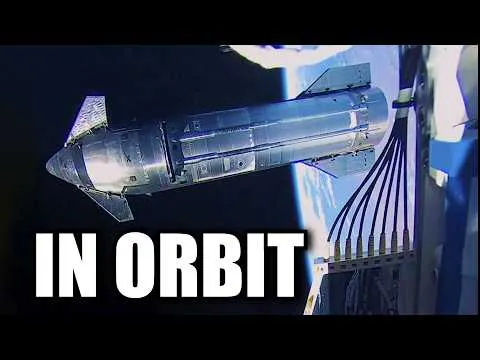
Scott Manley, space analyst and commentator, reviews the historic first orbital flight of SpaceX’s Starship, highlighting the cautious approach to engine reliability, daylight satellite deployment, and the partial mission success that marks a significant advancement in Starship development.
In their own words
“The go no go poll for orbit has finished and we are go for orbit.”
- SpaceX stream commentator · 11:35
“September 28th is now officially orbit day.”
- Scott Manley · 26:30
Key takeaways
- Starship’s upper stage design prioritizes survivable re-entry, preventing it from being uncontrolled in orbit, which shapes launch and mission decisions. (1:00)
- Despite having reached orbit in previous tests, prior Starship flights were intentionally held short of orbit due to Raptor V3 engine reliability concerns and risk management. (1:30)
- Raptor V3 engines still experience failures during ascent, compelling SpaceX to plan cautious missions with early abort options to mitigate in-flight risks. (1:30)
- This flight successfully deployed 26 Starlink V3 satellites in daylight, enabling unique engineering camera footage capturing full-color views of satellites and deployment mechanisms.
- Starship reached a significant orbital altitude of 275 km, temporarily raising its perigee above the atmosphere with a brief sea-level Raptor engine burn.
- For the first time, Starship orbit mission duration tripled previous flights, with deployment and flight control including three planned landing sites based on vehicle health.
- In-flight issues included a vacuum engine failure near final boost, causing initial abort poll reversal and eventual mission continuation, ending short of planned six orbits.
- Orbital maneuvers included controlled venting and RCS usage to separate Starship from deployed Starlink satellites and safely manage deorbit trajectory.
- The booster relit engines in an asymmetric pattern for trajectory control during descent, producing observable hydraulic and acoustic phenomena documented through advanced imaging.
Starship Finally Goes Orbital After a Tense Deliberation!
Ellie in Space · 29 September 2026
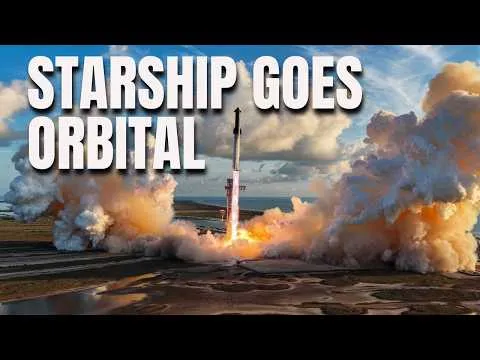
Starship, SpaceX’s next-generation launch vehicle, achieved orbit and deployed 26 operational Starlink V3 satellites after a tense engine issue during ascent, marking a milestone 18 years after Falcon 1’s orbit. The mission overcame engine shutdown by adapting burns, ending with a controlled splashdown.
In their own words
“It’s poetic that Starship reached orbit 18 years to the date after the Falcon 1 rocket. Orbit day should be a perpetual holiday at the company.”
- Eric Burgerer (SpaceX employee) · 9:00
“It’s hard to convey just how much was riding on flight four… 18 years to the day later, Starship reaches orbit and deploys the first operational V3 Starlinks.”
- John Edwards (SpaceX employee) · 9:30
Key takeaways
- Starship reached orbit after approximately 3.5 years since its first launch attempt and successfully deployed 26 operational Starlink V3 satellites, demonstrating critical progress in SpaceX’s heavy-lift capability.
- One of the Raptor engines on the booster shut down during ascent, but mission success was maintained by elongating burn times of remaining engines to compensate for thrust loss. (2:31)
- Flight control had a 10-minute deliberation debating aborting orbital insertion due to missing data from one engine, but ultimately proceeded recognizing three healthy sea-level Raptors would perform subsequent burns. (7:00)
- The Superheavy booster ignited all 33 Raptor 3 engines with 31 re-ignited for boost back burn and a controlled staged landing sequence concluded by a planned flight termination system activation as a safety demonstration. (4:00)
- Originally planned for six orbits spanning about 10 hours, the mission was shortened as a precaution following the engine anomaly to ensure safety and mission success. (8:30)
- Starship successfully relit a single Raptor sea-level engine for orbit insertion, deployed all planned satellites which engaged laser, ground, and user links, then executed a controlled deorbit burn and splashdown in the northern Pacific Ocean. (8:00)
- Following this success, SpaceX anticipates increasing the Starship flight cadence with Flight 15 aimed for October. (10:00)
Starship’s 14th Flight - Orbiting Safely?
Scott Manley · 28 September 2026
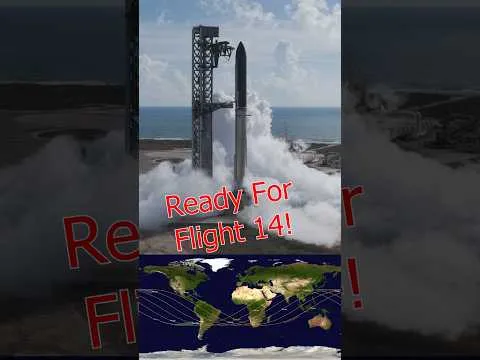
This episode covers SpaceX’s Starship Flight 14, the first planned mission aiming for proper orbit rather than a suborbital arc. It outlines the complex multi-stage mission plan with numerous go/no-go points and highlights the significant uncertainty around Starship’s final landing success.
In their own words
“This flight will be Starship’s first attempt at achieving a proper orbit instead of just a suborbital hop.”
- Narrator · 0:30
“Controllers have a series of go or no-go decision points to safely navigate this complex mission.”
- Narrator · 0:30
Key takeaways
- Starship Flight 14 aims to complete a proper orbit, distinguishing it from all prior suborbital Starship flights, marking a crucial milestone for SpaceX’s ambitions. (0:30)
- The mission could last nearly 10 hours, involving six orbits around the Earth, with ground controls holding multiple key decisions throughout to either continue or abort phases. (0:30)
- The launch places Starship suborbitally in about 9 minutes, after which a 15-minute window is allocated to decide on performing the orbit insertion burn. (1:00)
- If orbit insertion is aborted, Starship reenters and lands in the Indian Ocean, replicating previous recovery attempts. (1:00)
- Upon successful orbit insertion, SpaceX plans to deploy Starlink satellites and obtain daylight photos of Starship in orbit, providing valuable mission and vehicle data. (1:00)
- Following satellite deployment, engineers have approximately one hour to decide if Starship should return early, with a potential re-entry burn near the Philippines targeting a contingency landing north of Hawaii. (1:30)
- If early return is rejected, Starship will stay in orbit for about four more orbits, hoping the spacecraft remains healthy to conduct a de-orbit burn between India and China. (1:30)
- The final planned landing is roughly 1,000 miles west of Chile; however, SpaceX anticipates Starship will likely explode on landing despite not ruling out successful touchdown. (1:30)
- Although SpaceX hoped to catch Starship with the launch tower during landing to recover it intact, this catching capability remains for future flights. (1:30)
SpaceX Found a Piece of Ship 41 on the Beach. Here’s what that means.
What about it!? · 4 October 2026

Felix Schlang, host of the What About It Space podcast, reports that after Starship Ship 41’s partial orbital flight, a heat shield tile was recovered at Boca Chica beach, confirming durable design despite tile loss. Meanwhile, SpaceX advances infrastructure at Starbase Louisiana and NASA plans an unprecedented public air show at Kennedy Space Center.
In their own words
“Ship 41 was the first Starship to reach orbit despite losing one Raptor engine early in the ascent.”
- Felix Schlang · 1:00
“The heat shield tile found on Boca Chica beach is a hexagonal ceramic tile the size of a dinner plate, fixed with pins and coated with a metallic felt layer.”
- Felix Schlang · 2:00
Key takeaways
- Starship Ship 41 reached orbit despite early shutdown of one Raptor engine, demonstrating resilient orbital flight capability with automatic re-entry maneuvers. (1:00)
- A hexagonal ceramic heat shield tile from Ship 41 was found intact on Boca Chica beach, proving that tile shedding can occur early during ascent without compromising safe reentry.
- Some heat shield tiles from the previous Starship Ship 40 were reused on Ship 41, with comprehensive camera and orbital inspection data collected to refine future heat shield designs. (3:30)
- Ship 41 executed four distinct flight attitudes during its mission - vertical launch, heat shield sun orientation, reverse thruster burn, and atmospheric entry prep - using cold gas thrusters for control.
- The 26 Starlink Gen 3 satellites deployed from this mission form a tightly flying train delivering 26 terabits per second bandwidth, enough to serve roughly one million homes streaming 4K video simultaneously.
- SpaceX filed a major construction permit for Starbase Louisiana involving a 15.5-mile heavy haul road, an 8110-foot bridge over swamps, and new wharf facilities to support future launch infrastructure.
- NASA will host the largest public airshow ever at Kennedy Space Center November 7-8, 2026, allowing visitors to park on the Shuttle runway and experience historic astronaut appearances, aircraft displays including the experimental X-59, and Artemis hardware.
- Concurrent operations at Cape Canaveral continue at high cadence with both crewed ISS Falcon 9 launch and classified Falcon Heavy mission on the same day, while transitioning towards Starship-based missions in the future.
Earth’s expanding attack surface.
T-Minus: Space-Cyber Briefing · 4 October 2026 | 16:30 | S2 E727
Milenko Starčić, cybersecurity lead at Vision Space, and Andy Olchawa, senior cybersecurity engineer there, reveal how space cybersecurity is shifting from compliance to a broader threat landscape as emerging technologies expand Earth’s attack surface into space. They highlight digital simulations and open-source study as key learning tools for space-specific skills.
In their own words
“Most cybersecurity jobs in space focus on compliance and auditing rather than offensive security or penetration testing.”
- Milenko Starčić · 4:30
“You can simulate a space mission digitally on your laptop to learn telecommands and telemetry.”
- Andy Olchawa · 6:01
Key takeaways
- Most cybersecurity roles in the space sector currently focus on compliance and auditing rather than offensive or penetration testing, reflecting the industry’s early-stage security maturity. (4:30)
- As the space cybersecurity field grows, the burden of compliance requirements is increasing similarly to other technology sectors, potentially diverting focus from active defense. (5:00)
- Many space-specific cybersecurity skills can be developed through open source intelligence by studying public standards and the software used in space missions, enabling accessible entry to this niche field. (5:30)
- It is possible to digitally simulate an entire space mission on a personal computer to understand telecommands and telemetry systems deeply, enhancing practical training without costly hardware. (6:01)
- Direct-to-device satellite internet services for mobile phones are expected soon, which will greatly increase the consequences of any cyber outages by impacting millions directly. (12:30)
- The proliferation of space infrastructure such as data centers in orbit and lunar bases will dramatically enlarge the attack surface, presenting cyber risks comparable to or exceeding those seen on Earth. (13:30)
- Moon bases and extraterrestrial facilities will experience cybersecurity vulnerabilities similar to terrestrial aerospace assets, making them attractive and plausible targets for cyber exploitation. (14:00)
- Returning to the moon with infrastructure development within the next 2 to 10 years will transform space hacking from a science fiction concept into a real and urgent cybersecurity challenge. (15:00)
World’s Largest Slingshot Threw A Spacecraft To Earth!
Scott Manley · 1 October 2026
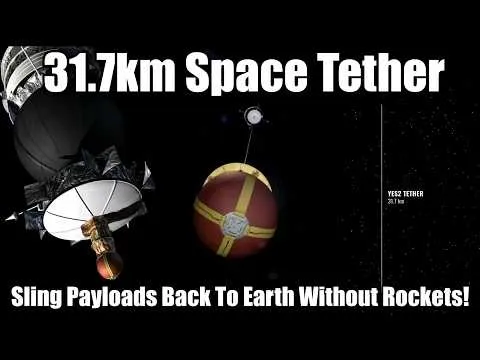
Scott Manley analyzes the 2007 European Space Agency YES2 mission, which uniquely deployed a 31.7 km tether in space to swing a small re-entry capsule back to Earth without rocket propulsion, setting a record for the longest tethered spacecraft. Despite success in deployment, the capsule’s exact fate remains unknown.
In their own words
“The mission holds the record for the longest satellite ever launched, at 31.7 km tether length.”
- Scott Manley · 13:30
“In modern space environment, deploying a 30 km tether would be controversial due to collision risk with satellite constellations.”
- Scott Manley · 14:00
Key takeaways
- YES2 was a European Space Agency project involving students, aimed to deploy a 30+ km tether from the Photon spacecraft to return a payload to Earth without engines. (2:30)
- The tether deployment system included three parts: Floyd (30 km tether spool), Mass (mechanical/data mass), and Fotino (re-entry capsule). (5:00)
- Deployment began with a pendulum-like swing created by gravitational tidal forces after the tether was released at about 3 m/s, extending initially 2 km and eventually reaching 31.7 km length.
- A ‘barber pole’ style braking system regulated tether deployment friction to control speed and prevent oscillations during deployment. (7:00)
- Sensor power loss after 8 km prevented direct telemetry; however, accelerometer data detected oscillations confirming the full tether length deployed.
- The capsule deorbited earlier than planned due to early release at higher velocity, causing loss of telemetry and no recovery signal.
- The capsule may have landed downrange near the Aral Sea, possibly in a lake, remaining unfound despite a $1,000 reward offered for its return.
- YES2 demonstrated that very long tethers can be deployed and used for controlled spacecraft deorbit without rockets but such deployments today are controversial due to collision risks with satellite constellations.
The Space Show Presents An Open Lines Discussion
The Space Show-One Giant Leap Foundation · 30 September 2026

David Livingston hosts an open lines discussion featuring insights on space commercialization and policy with references to historian Rainer Zitelmann’s views on legal frameworks for space. The episode also covers cybersecurity challenges faced by The Space Show’s website, developments in spaceflight reliability, and the emergence of advanced nuclear-powered missile technology.
In their own words
“Since Eisenhower, there’s a bright line drawn between civil space and the military.”
- Lori Garver (quoted) · 47:30
“Their fight song will be a modern version of Kumbaya.”
- Host (joking about Space Academy) · 56:01
Key takeaways
- Historian and engineer Rainer Zitelmann argues that establishing property rights and legal frameworks is essential for a viable free market beyond Earth, as current technical capabilities for Mars colonization and asteroid mining are sufficient but lack economic infrastructure.
- The Space Show’s website suffers from excessive crawler bot traffic, especially from AI language models, overwhelming server resources and forcing a migration of new content and community interaction to platforms like Substack and YouTube for better stability.
- The U.S. Space Academy is proposed as a critical institution for developing specialized space leadership, vocabulary, and training distinct from Air Force endeavors, but political and budgetary challenges make near-term establishment difficult.
- Development of Russian nuclear-powered cruise missile technology, using molten salt reactors heating air without radioactive exhaust, represents a significant advancement with potential for ultra-long-range flight, posing challenges to existing missile defense systems like Golden Dome.
- Achieving around 100 consecutive successful rocket flights is viewed informally by veteran engineers as a benchmark for launch vehicle reliability sufficient to carry humans, surpassing current demonstration flight counts for some suborbital companies.
- Small space-related startups, such as Cosmic Robotics, are already deploying autonomous technology for lunar and Mars construction tasks, supported by NASA SBIR awards, signaling maturation of robotic support for extraterrestrial infrastructure.
243 - What Does True Resilience Look Like Across the Space Enterprise?
Constellations - Explore Space Network Technologies with Industry Leaders · 1 October 2026 | 26:48 | S1 E243

Dr. David Voss, Director of the Spectrum Warfare Center of Excellence at the Space Warfighting Analysis Center, discusses how true resilience in space enterprise depends on hybrid, multi-orbit architectures integrated with commercial and allied services. He emphasizes designing systems for graceful degradation, cross-capability integration, and open standards to ensure operational continuity under diverse threats.
In their own words
“True resilience in space architecture means the system can continue delivering needed capability despite interruptions from natural or adversary causes.”
- Dr. David Voss · 7:00
“Homogeneous systems lack graceful degradation; resilience requires broad-spectrum capabilities across multiple orthogonal threat vectors.”
- Dr. David Voss · 7:30
Key takeaways
- Space enterprise has evolved from discovery and homogeneous constellations to a current era of hybrid architectures that leverage multiple orbits and allied commercial services, requiring new analytical frameworks to optimize investments.
- True resilience means systems continue delivering required capability despite natural or adversarial interruptions, requiring broad-spectrum defenses against kinetic, nuclear, reversible, and irreversible threats, moving beyond fragile homogeneous systems.
- Designing for resilience implies acceptance that node loss and failures are normal; operations must include practicing for disruptions like GPS outages to develop hybrid Positioning, Navigation, and Timing (PNT) architectures.
- Proliferated smallsat constellations must focus on delivering capabilities and services, not specific satellite solutions, encouraging government acquisition to specify desired functions to enable innovation and vendor diversity.
- Ground segments remain critical mission components; legacy architectures tied to fixed hardware locations produce fragility, motivating adoption of software-defined, cloud-enabled ground systems with layered interoperable communication networks.
- Open standards tied to specific phenomenologies are essential for coalition interoperability and technology adoption; a community-driven approach is needed rather than government-only technical standard authorship.
- Artificial intelligence can assist in managing the complex emergent behavior of hybrid space networks by dynamically optimizing data routing and network quality of service, but must be applied cautiously with human oversight in high-stakes space operations.
- Current GPS infrastructure is insufficient for space service volumes; developing ubiquitous communication and PNT coverage across LEO, MEO, and GEO orbits would transform mission temporal resolution, latency, and enable new AI-enabled space and terrestrial capabilities.
T+340: Starliner’s Future and the Demand Signal
Main Engine Cut Off · 30 September 2026 | 33:28 | E340
This episode features Anthony Colangelo analyzing Boeing’s Starliner future amid NASA’s extended ISS plans and weak commercial demand for crewed low Earth orbit flights. The discussion highlights strategic shifts toward lunar exploration and challenges in fostering sustainable LEO commercial markets.
In their own words
“If we were gonna walk away from Starliner, we would’ve done that in February.”
- Jared Isaacman · 16:00
“Here’s the demand signal. Not a lot. You tell me if you can make that a business, then great.”
- Jared Isaacman · 17:00
Key takeaways
- Starliner-1 (uncrewed) is planned no earlier than December 2027, and Starliner-2 (crewed) for mid-2028, with schedule gaps posing risks of further delays. (2:00)
- NASA’s $350 million contract modification with Boeing funds Starliner’s return-to-flight and Vulcan rocket certification as Atlas V rockets phase out. (3:00)
- NASA publicly said no current commercial market exists to replace ISS with commercial space stations through the 2030s, provoking industry backlash and a swift NASA reversal. (5:00)
- Congress strongly supports extending the ISS to 2032, reinforcing NASA’s commitment and influencing its stance on commercial station programs. (8:00)
- SpaceX plans to shift from Falcon 9/Dragon to Starship, leveraging Starship’s larger payload and new business models, while likely pausing crewed Earth-to-LEO flights until Starship matures.
- Demand for crewed commercial LEO flights remains low, about two astronauts every 6 to 9 months plus international partners, insufficient to sustain a third crew transportation provider. (16:30)
- NASA’s focus and funding prioritize lunar exploration and presence over LEO operations, viewing maintaining ISS as costly with limited strategic value.
- Despite market challenges, NASA continues investing about $360 million to complete Starliner, yielding a high seat cost around $90 million, which burdens commercial station market viability. (24:30)
- Commercial space station companies struggled coordinating crew transport with Boeing and SpaceX, exposing economic and operational challenges in developing a sustainable market. (31:00)
- Vast Aerospace’s new Lunar Programs Division exemplifies industry pivoting from uncertain commercial LEO markets toward lunar surface habitation and exploration. (26:00)
The Space Show Presents Anastasia Prosina, Space Architect on human space flight investment and more.
The Space Show-One Giant Leap Foundation · 30 September 2026
Anastasia Prosina, space architect and founder of Stellar Amenities Lab, discusses critical funding gaps in maturing human spaceflight technologies, the necessity of long-term investment, and the strategic challenges of lunar habitat development amid geopolitical competition. She emphasizes human presence for consciousness and scientific discovery in space.
In their own words
“There is a valley of death between TRL 4 to 7 where many space technologies fail to mature due to lack of scalable investment.”
- Anastasia Prosina · 6:00
“Less than 1% of private investment goes to human spaceflight technologies, the rest focuses on scalable infrastructure.”
- Anastasia Prosina · 9:30
Key takeaways
- There is a significant ‘valley of death’ in technology readiness levels 4 to 7 where human spaceflight innovations fail to mature due to insufficient scalable investment and long procurement cycles, impeding progress.
- Less than 1% of private space sector investment in 2026 targets human spaceflight technologies; most venture capital prefers scalable infrastructure over critical human factors tech like life support. (9:30)
- Humans remain indispensable in space exploration due to dexterity and versatility that robots cannot yet replicate, underscored by national security mandates prioritizing crew systems for survivability.
- Stellar Amenities Lab aims to pioneer the largest, most comprehensive dataset on the human body in space over the next decade to understand aging and DNA-level effects related to long-duration missions.
- Lunar construction is complex, requiring a four-phase framework - site prep, utilities, shell building, habitat fit-out - with challenges coordinating multiple stakeholders, mission goals, and decisions on habitat distribution and lander roles.
- Current government space efforts suffer from short-term planning horizons and componentized funding that hinder holistic human settlement visions, contrasting with global cultures practicing longer-term strategies.
- Space architecture should integrate principles from terrestrial architecture emphasizing well-being and productivity, such as natural light and environmental variety, as astronaut comfort directly increases mission returns.
- Human consciousness preservation in space and the need for multiple existential ‘baskets’ for survival justify sustained human presence despite high economic and technological challenges.
#174 | Persistant Imaging | Mark Keremedjiev, Orbital Sentry
Space Business Podcast · 29 September 2026

Mark Keremedjiev, founder and CEO of Orbital Sentry, discusses the company’s innovative approach to continuous 24/7 Earth imaging from geosynchronous orbit, addressing limitations of low Earth orbit satellites for real-time wildfire detection and defense monitoring.
In their own words
“One of the greatest values for methane monitoring is to know exactly when an emission starts and stops, which requires continuous awareness.”
- Mark Keremedjiev · 47:30
“I have kids and I’m introducing them to ‘Star Trek: The Next Generation’; it’s been a big influence on me, evolving from admiring engineer Geordi La Forge to admiring Captain Jean-Luc Picard as a CEO.”
- Mark Keremedjiev · 49:30
Key takeaways
- Orbital Sentry provides persistent Earth observation from geosynchronous orbit, allowing continuous monitoring without revisit delays common in low Earth orbit (LEO) satellites, critical for fast-evolving events like wildfires and battlefield activity.
- Temporal resolution is more impactful than spatial resolution for applications like wildfire detection; GEO satellites trade off spatial detail for continuous coverage, enabling near video-rate data at 250-500 meter resolution.
- Most US wildfire destruction comes from fast fires lasting 2-4 days, so relying on infrequent LEO satellite passes misses key early detection windows; a continuous monitoring approach can improve containment and reduce damage.
- Orbital Sentry targets economically valuable regions with each satellite, like the entire western US, offering subscription data products to insurers, utilities, and large landowners while providing wildfire data free to first responders.
- Advances in launch vehicles and satellite bus providers are lowering the historically high costs of GEO satellites, making persistent geostationary imaging commercially viable compared to large LEO constellations.
- Onboard data processing is minimized due to continuous GEO ground station contact, enabling rapid Earth-based processing and refining detection algorithms to minimize false alarms critical in wildfire and defense contexts.
- Orbital Sentry’s technology also supports real-time defense surveillance, tracking artillery and drones persistently, capabilities impossible with LEO due to their revisit frequency and limited coverage.
NASA’s SpaceX Crew-13 Launch
NASA · 29 September 2026
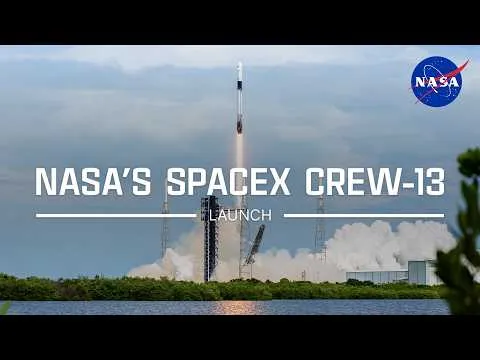
NASA astronaut Jessica Watkins commands SpaceX Crew-13’s mission to the ISS, underscoring teamwork and groundbreaking research including stem cell studies and plant growth in microgravity. The mission advances human presence in orbit and supports Artemis Moon and Mars exploration programs.
In their own words
“Human space flight is truly a team sport, and it is an honor and privilege to represent all of you who have contributed to the success of this mission with gratitude and grace.”
- Jessica Watkins · 1:42:28
“Courage is grace under pressure.”
- Jessica Watkins · 2:01:30
Key takeaways
- Jessica Watkins is the first NASA astronaut to fly two SpaceX Dragon missions and leads Crew-13 with an emphasis on teamwork likened to rugby, highlighting collaborative success in human spaceflight.
- Crew-13 will conduct critical research on human stem cell-derived tissues for diseases like heart disease and Parkinson’s, continuing vital biomedical investigations aboard the ISS.
- The mission will expand plant growth experiments, deploying the autonomous Halo 3 chamber and testing new “plant pillows” to improve sustainable food production for long-duration lunar and Mars missions.
- Launch employs a rigorous safety framework including the launch escape system armed before fueling, real-time monitoring of fractious Florida weather, and strict crew quarantine protocols before liftoff.
- Spacewalks remain vital for ISS maintenance and upgrades, with Crew-13 planning EVAs informed by extensive ground training in neutral buoyancy and using robotic arms to enhance efficiency.
- International collaboration defines Crew-13, including NASA astronauts, Canadian Space Agency astronaut Josh Kutryk expecting his third child during flight, and Roscosmos cosmonaut Sergey Teteryatnikov, reflecting global cooperation in space.
- SpaceX’s Falcon 9 rocket and Dragon spacecraft ‘Grace’ provide reliable transportation with key milestones like instantaneous launch windows for rapid eight-hour ISS docking, potentially setting new speed records.
- Research aboard ISS advances human knowledge benefiting Earth and space, including insights into aging, immune response, and new disease treatments, enabled by over 25 years of continuous international operation.